- Call Us: +91-9988543543

14th September 2026 | By Admin
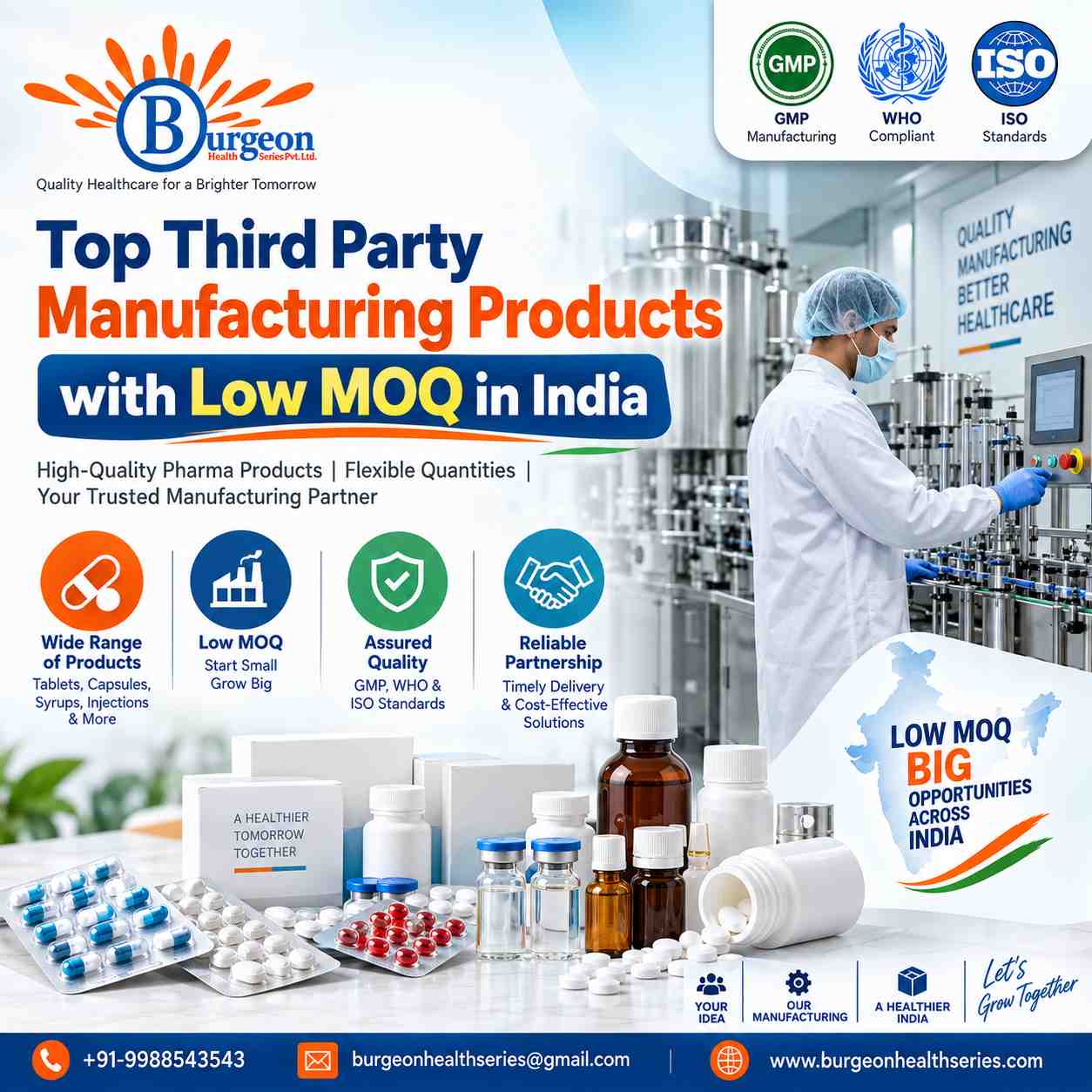
Third party manufacturing products have become the backbone of India's fast-growing pharma franchise business, giving companies of every size a way to build a full product range without owning a single manufacturing unit. For a new PCD franchise holder or a small distributor testing a new therapeutic segment, ordering in bulk from day one is rarely practical — money gets tied up in stock, storage becomes a headache, and slow-moving SKUs eat into margins. Here’s precisely where the lower MOQ plays its role. The company can start at a smaller level, find out about the demand for various products such as tablets, capsules, syrups, injections and topicals and grow only after proving that the product works well in the market.
A simple yet effective business model, the Third Party Manufacturing business process involves a marketing or franchise business designing and selling the pharma product, while the manufacturing of the product, along with its quality control and packaging, is performed by an external manufacturing entity. In the case of Pharmaceutical Third Party Manufacturing, the branding business does not have to incur any cost for the equipment and other necessary things because it is already available with the manufacturing company, and they just have to produce the required quantity of the batch according to the needs of the client.
The system is reciprocal in nature. The Third Party Pharma Manufacturing Company is able to generate stable production income from its capacity by producing batches for several clients, and the marketing or franchise business gets their required batch without having to bear the initial costs of establishing a factory. It is due to this reason that Third Party Pharma Manufacturing has been one of the most common entry strategies into the Indian Pharmaceutical Distribution network through PCD Pharma Franchise business models.
Pharmaceutical manufacturing facilities in India are distributed among well-established clusters in places like Himachal Pradesh, Uttarakhand, Gujarat, and Telangana, where WHO-GMP-certified facilities already manufacture for dozens of franchise brands. This is the very reason why third-party manufacturing has become such a huge success because a franchise brand operating out of one region of the country can collaborate with any facility operating in this cluster region without being restricted by location when selecting products or prices.
Not every Third Party Manufacturing Company sets the same order threshold, and this difference matters more than most new entrants realise. A high MOQ forces a business to commit heavy capital to a single product before knowing how it will actually perform in a given territory. Low-MOQ 3rd Party Manufacturers remove that pressure by allowing smaller trial batches, which is particularly useful when:
Working with 3rd Party Manufacturing partners that offer flexible batch sizes also reduces the risk of expired or dead stock, which is a common problem in pharma distribution given fixed shelf lives. A manufacturer willing to run smaller runs is usually a sign of an efficient, well-organised production line rather than a compromise on quality.
Certain categories of pharmaceuticals are always available through low MOQ deals owing to the use of standard excipients, formulations and packaging equipment in them, which allows manufacturers to produce them efficiently in smaller quantities. When evaluating 3rd Party Manufacturing Pharmaceuticals, these are the categories of pharmaceuticals that are taken up by franchises initially:
Tablets and Capsules: The multivitamin combinations, Antibiotics, pain management and gastro categories are the most commonly required Third Party Manufacturing Pharmaceuticals because of the high level of standardization in tablet and capsule manufacturing units.
Dry Syrups and Liquid Orals: The formulations for children, cough & cold syrups, and digestive tonics fall into this category of pharmaceuticals, which are preferred by many manufacturers for producing in smaller batches.
Injectables: While injectable manufacturing demands stricter sterility controls, many third party manufacturing pharma companies now offer moderate MOQs for small-volume injections and vials, making it possible for critical care and hospital-supply franchises to start without massive upfront orders.
Derma and Topical Ranges: Creams, ointments, gels, and lotions can work well at low MOQ start-ups since in derma ranges, manufacturers can create different variants by adding a different active in the same base formula used across several derma variants.
Ayurvedic Formulations and Herbal Range: Traditional and proprietary Ayurvedic formulations such as powders, capsules, and syrups can be easily made available in low MOQs, enabling Ayurvedic franchise businesses to quickly grow across smaller cities.
Nutraceuticals and Proteins: With the increased need for wellness products in recent years, most manufacturers have started making batch quantities for sachets, effervescent tablets, and proteins, giving new businesses the ability to see how consumers react to the product.
Combining some of these segments, instead of distributing investments across many SKUs, is generally more sensible.
Not every low-MOQ offer is equal, and a lower order threshold should never be the only deciding factor. A reliable Pharma Third Party Manufacturing Company should be evaluated on a combination of the following:
1. Certifications and compliance: WHO-GMP, Schedule M compliance and a valid CoPP (Certificate of Pharmaceutical Product) where export ambitions exist.
2. Product range and formulation flexibility: The ability to customise dosage forms, combinations, and packaging rather than offering only fixed catalogue products.
3. Consistent batch quality: A manufacturer's track record on stability testing and batch-to-batch consistency matters more over time than the initial order size.
4. Transparent pricing and PTR/PTS structure: Clear documentation on pricing to retailers and stockists avoids disputes later in the distribution chain.
5. Turnaround time and communication: Smaller batches are only useful if delivery timelines are dependable enough to support a growing franchise network.
Comparing a shortlist of Third Party Manufacturing Companies against these points, rather than choosing purely on quoted MOQ, tends to produce a far more stable long-term partnership. It also helps to ask for sample batches, visit or virtually audit the manufacturing unit where possible and request references from existing franchise partners before signing a long-term agreement.
Beyond flexible order sizes, working with established Third Party Manufacturing Pharma Companies offers several advantages that directly support business growth:
• Reduced investment on capital: As there will be no need to construct and maintain a manufacturing plant, more resources can be invested in marketing and distributing the products.
• Quick access to the market: Product can go from approval stage to the shelves much quicker as compared to setting up the in-house manufacturing.
• Expertise: The manufacturer already possesses formulation expertise as well as the regulatory knowledge that may be missing in the new franchise company.
• Scalability: As the performance of particular products and markets increases, order quantity can be gradually scaled up without having to reconsider the business model.
• Risk reduction: The responsibility of quality assurance, batch tests, and compliance is part and parcel of the manufacturer's job.
Such factors of low risk and scalability are some of the reasons why third party manufacturing is continuing to grow as the favoured approach for launching new pharma franchise companies in India.
Q1. What does MOQ mean in third party pharma manufacturing?
MOQ, or Minimum Order Quantity, is the smallest batch size a manufacturer will produce per order. A low MOQ lets franchise businesses start with smaller stock commitments while testing demand for a product in their territory.
Q2. Is low-MOQ manufacturing suitable for a new PCD franchise business?
Yes, it is often the better starting point. New franchise businesses can trial multiple products across segments without overcommitting capital, then reorder larger quantities only for the products that actually sell well.
Q3. Do low-MOQ manufacturers compromise on quality?
Not necessarily. Many WHO-GMP certified manufacturers offer smaller batches purely due to efficient production planning, not reduced quality standards. Checking certifications remains essential regardless of order size.
The selection of the best approach for Third Party Manufacturing Products is not just a matter of having the smallest MOQ but rather a combination of a company that offers flexible MOQs along with high-quality products, certification and timely delivery. With franchise companies, distributors, and new entrants in India's pharma industry, offering low-MOQ products across all kinds of pharmaceutical products makes it easy to develop a wide range of products without any burden on finances. As the industry continues to grow, businesses that pair the right product mix with a dependable manufacturing partner will be best placed to scale sustainably in an increasingly competitive market.
Must Read: Top PCD Pharma Franchise Company in Haryana